“Safety first, safety second, safety third.”
That’s the first thing the hundreds of children who come through the First Tee of Syracuse summer program hear before they touch any sort of golf club.
The man who calls out that order is 70-year-old Robert Dixon, the walrus-mustachioed, sunglass-wearing head coach of the program. He’s gone through this warm-up routine hundreds of times but still finds ways to keep things interesting.
He might say why you should make your bed in the morning, why you should try to meet new people, or why honesty is so crucial in the games of golf and life.
Dixon has been in coaching for nearly 50 years. And while a lot has changed in the five decades since, he still loves what he does.
He loves to tell stories too.
It could be about something that happened during his golf league, a memory from his nearly three decades working at Nottingham High School in Syracuse, or his days as an undergraduate at SUNY Cortland.
Most of the other coaches at First Tee think they’ve heard every Dixon story—and there are quite a few.
“Sometimes we’ll look at each other when he starts to tell a story because we know what’s coming,” said Kira Graves, a coach at the First Tee program. “But it doesn’t make it any less entertaining.”
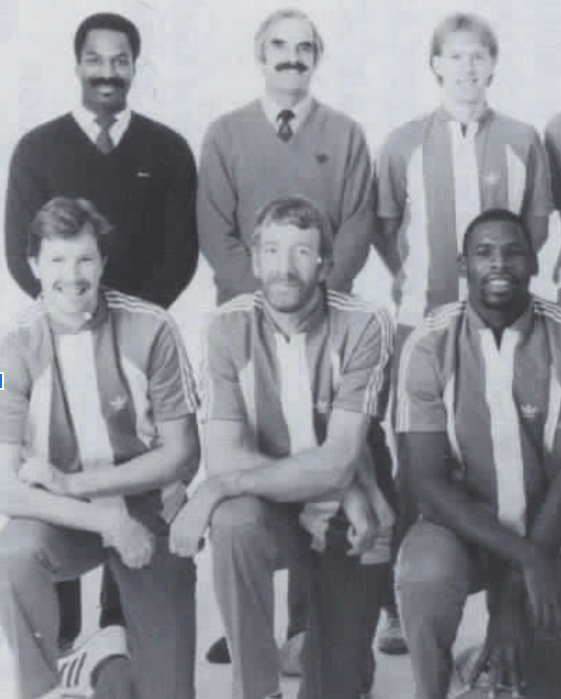
But there’s one story a lot of people don’t know. Dixon coached professional basketball in England and Scotland for four years during the 1980s.
He was a standout athlete at Rome Free Academy and went on to get a physical education degree from Cortland by way of Mohawk Valley Community College. Like many Cortland graduates, Dixon jumped head-first into a coaching career.
He got work coaching junior varsity basketball at his alma mater, then went to Brockport to work under Bill Van Gundy (the father of future coaches Jeff and Stan Van Gundy), before going to Poughkeepsie to assume the head coaching role at Dutchess Community College.
“I remember he used to call me after some of the games,” said Dale Greabell, his roommate at Cortland. “You could tell how much he cared and a lot of those were just JV games to start with…He would always talk and talk in all this detail.”
Then, a chance encounter helped Dixon find his big break.
Dixon was serving as a counselor at a large summer basketball camp in the Hudson Valley. One of his roles was to take the campers through an exercise routine to get them warmed up.
“I was up there on a platform in front of a few hundred kids doing my thing,” Dixon remembered. “And (former Syracuse men’s basketball head coach) Jim Boeheim was there. After the session, he comes over to me and asks me if I want to be a grad assistant.”
In three seasons at Syracuse, Dixon coached players like Leo Rautins, Gene Waldron, Tony Bruin, Rafael Addison, and a young guard from New York City named Dwayne Washington.
In his final season, Dixon was on the bench for one of Washington’s defining moments in an Orange uniform.
On Jan. 21, 1984, Washington sank a buzzer-beater from half-court to stun Boston College and send the Dome into delirium.
“When that ball went in, I swear everyone on that bench jumped at least a foot off the ground,” said Dixon, who proudly has a picture of that moment displayed in his living room.
Following that season, Boeheim came to him with an opportunity. Dixon figured it would be a coaching job at another college. He was wrong. It was on the other side of the Atlantic Ocean.
“(Boeheim) tells me it’s in England,” Dixon said. “I’d never been out of the country. I didn’t have a passport. Boeheim tells me to give him my birth certificate, and he gets a passport for me in three days.”
The job was in Leicester, in the English Midlands. Dixon had a week to get himself together before leaving for the job. He had another week to get to know his team before the season started.
“It was all international rules,” he said. “We never played any of that, guys could take the ball off the rim once it hit the rim—things like that.”
His Leicester team—sponsored by Walker’s Crisps (potato chips to us Yanks)— was a pretty solid squad led by Waldron, one of Dixon’s old players at Syracuse, and Clyde Vaughan, who played at Pittsburgh.
In his first season, the team made it to the finals of the National Basketball League—then the top flight of English basketball. Once the season came to an end, Dixon returned to Syracuse to bartend for the four-month offseason, something he did every year he coached in England.
While England proved to be quite a cultural adjustment, Dixon enjoyed his time in Leicester.
“It was actually more diverse than I thought,” he said. “I mean, you would go to London, and it’s like a different world down there, but there was still plenty to do in Leicester…I hung out a lot with these West Indian guys, and they would come to all our games and be some of our loudest fans.”
The City Riders—as they became known in Dixon’s second season—played at a small arena called Granby Halls, where the team would regularly pack in three or four thousand fans.
In his time in Leicester, Dixon never moved out of the local Holiday Inn. When fans found out where he was living, they would send beer to his room. He became something of a local celebrity, doing advertisements and even hosting a radio show.
After his third season with the City Riders (the local public transport authority took over sponsorship of the team), Dixon left for a better-paying job in Falkirk, Scotland.
His first week with the new team set the tempo for the year to come.
“The team manager stole my car,” Dixon remembered. “It took the police a week to find the guy. I should’ve known right then and there that this was gonna be a tough season.”
Playing in a hockey arena, his team didn’t win very many games in the 1987-88 season. Instead of the action on the court, it’s memories when the team wasn’t playing that stick out to Dixon more than his win-loss record.
There was a ferry ride that saw all the players and coaches throwing up over the side of the boat, a careful team trip through Belfast during the midst of The Troubles in Northern Ireland, and a close scrape with a barroom brawl in Falkirk.
“I’ll never forget when we were driving through the Irish countryside on a trip to a tournament,” Dixon said. “Apparently, we were riding in the same van (The Irish Republican Army) used to do their thing.
“We got stopped at a checkpoint, and then they saw a bunch of brothers in this van. They just waved us through. The van that had the white guys in it got stopped and searched, and they tore the thing up.”
After the season, Dixon made the move back to Syracuse permanently. He got a job teaching physical education at Nottingham High School and stayed in the Syracuse City School District for nearly three decades.
When the First Tee of Syracuse began in 2006, Dixon joined as the lead coach. Still in the same role today, he’s seen the program grow from a few dozen kids to almost 400. In all the years, he’s yet to tell any campers about his overseas adventure.
“All the kids need to hear is ‘pro basketball coach,’ and they would go crazy,” said Graves. “They love him enough already.”
“People have told me about writing a book about all this,” Dixon said. “I just don’t know who would read it.”
Anyone who has heard this Dixon story would beg to differ.
 Jonathan Kinane